Whether you are an athlete returning from overuse or someone managing daily activities, a structured eccentric loading program can help reduce pain and restore function. This article explains how eccentric loading works, practical protocols you can follow, and safety tips to support a successful recovery.
Understanding Achilles tendinopathy and the role of eccentric loading
Achilles tendinopathy refers to a painful, often gradually worsening condition of the Achilles tendon due to overuse or excessive loading. It is more common in the midportion of the tendon, though insertional forms at the heel can occur. The goal of rehabilitation is to promote tendon healing, improve strength and load tolerance, and prevent re-injury.
Eccentric loading targets the tendon’s remodeling process by emphasizing controlled lengthening under load. Evidence from sports medicine supports eccentric exercises as an effective core component of recovery, particularly for tendinopathy that does not resolve with rest alone. When performed correctly, eccentric loading can help reduce pain, increase tendon stiffness, and improve functional capacity.
How eccentric loading supports healing
- Promotes collagen synthesis and tendon remodeling, helping the tendon adapt to higher demands.
- Improves tendon stiffness and load tolerance, which can reduce pain during activity.
- Encourages gradual, progressive loading, aligning with how tendons heal in response to mechanical stress.
- Offers a simple, scalable approach that can be implemented with minimal equipment.
Practical eccentric loading protocols
Alfredson eccentric heel drop protocol (classic approach)
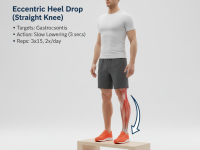
The Alfredson protocol is a well-known eccentric-only program for midportion Achilles tendinopathy. It involves standing on a step with the heels off the edge and performing eccentric lowering on the injured leg, using the non-injured leg only to push up. Typical guidance includes three sets of 15 repetitions, twice daily, for about 12 weeks. Progression is based on pain tolerance and functional improvement.
How to perform safely:
- Stand on a step with the injured leg on the edge and the heel off the step; the other leg should be available to assist getting up if needed.
- Rise up to the tiptoe using both legs to bring your body up, then slowly lower only the injured leg to the starting position in a controlled manner (3–4 seconds for the lowering phase).
- Do 3 sets of 15 repetitions, twice daily. If pain during or after reps is excessive (more than mild-moderate), reduce volume or take a recovery day.
- As symptoms improve, you can gradually increase resistance (e.g., adding ankle weights) or advance to single-leg variations when appropriate under guidance.
Heavy Slow Resistance (HSR) as an alternative or progression
Heavy Slow Resistance combines both concentric and eccentric loading of the calf muscles with a focus on slow, controlled movements. This approach is practical for athletes who prefer a broader strengthening protocol and may be more tolerable for some individuals. A typical program involves multiple exercises (calf raises, seated and standing variations) performed with significant resistance, slower tempo (e.g., 3–4 seconds on the lowering phase), and progressive loading over weeks.
A common structure might be:
- 3 sets of 8–12 repetitions, 2–3 days per week
- Tempo: 3 seconds lowering, 1–2 seconds lifting
- Incremental resistance as tolerated by pain and function
Safety, progression, and pain-monitoring
Progression should be gradual and individualized. Use pain as a guide, not a barrier: some discomfort during exercise can be acceptable, but pain that lasts beyond 24 hours or worsens with daily activities warrants modification or cessation of the exercise until symptoms settle.
- Start with pain-free or mild symptoms and gradually increase load as tolerance improves.
- Maintain proper technique to avoid compensatory movements that could stress the knee or calf more than intended.
- Incorporate warm-up and cool-down routines, stretching for the calves (gentle) and mobility work for the ankle as advised by a clinician.
- Address contributing factors such as training load, footwear, training surface, and conditioning for overall injury prevention.
Getting started and when to seek care
Who should consider a clinician-guided plan
Most individuals with persistent Achilles tendinopathy benefit from assessment by a physical therapist or sports medicine clinician. A clinician can assess tendon health, alignment, footwear, and loading history, then tailor a progression plan, monitor symptoms, and adjust exercises as needed.
Red flags to seek urgent care
If you experience intense, sudden heel pain, swelling with warmth, a audible snap, or inability to bear weight, seek medical attention promptly as these may indicate a rupture or another acute injury requiring a different treatment approach.
Practical tips for adherence and avoiding setbacks
- Schedule regular, short sessions for eccentric loading to build a consistent habit.
- Keep a simple pain diary to track symptom changes and correlate them with the exercises.
- Combine tendon-focused rehabilitation with gradual aerobic conditioning and strengthening for balanced recovery.
- Communicate openly with your clinician about pain changes, activity goals, and sport-specific demands.
Frequently asked questions
Can I continue running during eccentric loading rehabilitation?
Light endurance work may be possible depending on pain levels and functional tolerance. Many runners gradually adapt by decreasing intensity, volume, and adding Achilles-focused loading before resuming full running. Always coordinate with a clinician before returning to high-impact activities.
How long does recovery typically take?
Individual timelines vary. Some people notice improvements within 6–8 weeks, while others may take 3–6 months or longer, especially if symptoms were persistent. Consistent, progressive loading and addressing contributing factors are key to a successful outcome.
Create a high-resolution hero illustration for a medical rehab article. Show a fit adult wearing athletic clothes standing on a gym step with the heel of the injured leg hanging off the edge. The person performs a controlled eccentric heel drop while the other leg stabilizes the body. The scene is in a modern physical therapy clinic with soft natural lighting, a neutral palette, and visible ankle and calf anatomy highlight in subtle overlays. Include a calm, focused facial expression and a sense of careful progression. Add clear labeling of the key movement: “eccentric lowering” and “toe raise assist.” The image should convey clinical credibility and approachable self-guided rehabilitation.
Create a clean, educational infographic illustrating the Alfredson eccentric heel drop protocol. Use a simple two-panel sequence: Panel 1 shows standing on a step with both legs ready to push up, injured leg off the edge; Panel 2 shows lowering the injured leg slowly with a 3–4 second tempo. Include captions: “Phase: eccentric lowering,” “Reps: 15 per set,” “Sets: 3,” “Frequency: twice daily,” “Duration: 12 weeks.” Add a small side box with safety notes: “Pain should be mild during/after exercise; stop if sharp pain or swelling occurs.” Use leg anatomy silhouettes, arrows indicating movement, and color coding (injured leg in a calm red/amber to indicate caution, healthy leg in blue). The style should be clean, clinical, and easily shareable on social media.