Eccentric loading for Achilles tendonitis rehab is a highly effective, evidence-based approach that targets the damaged tendon with controlled lengthening contractions. This article explains how to perform eccentric exercises safely, progress load, and combine treatments for optimal Achilles tendinopathy recovery.
Why eccentric loading works
Eccentric exercises place the tendon under controlled tensile stress while the muscle lengthens, stimulating collagen remodeling and improving tendon capacity. Clinical trials and systematic reviews support eccentric training for mid-portion Achilles tendinopathy, showing reduced pain and improved function compared with wait-and-see or some other conservative treatments.
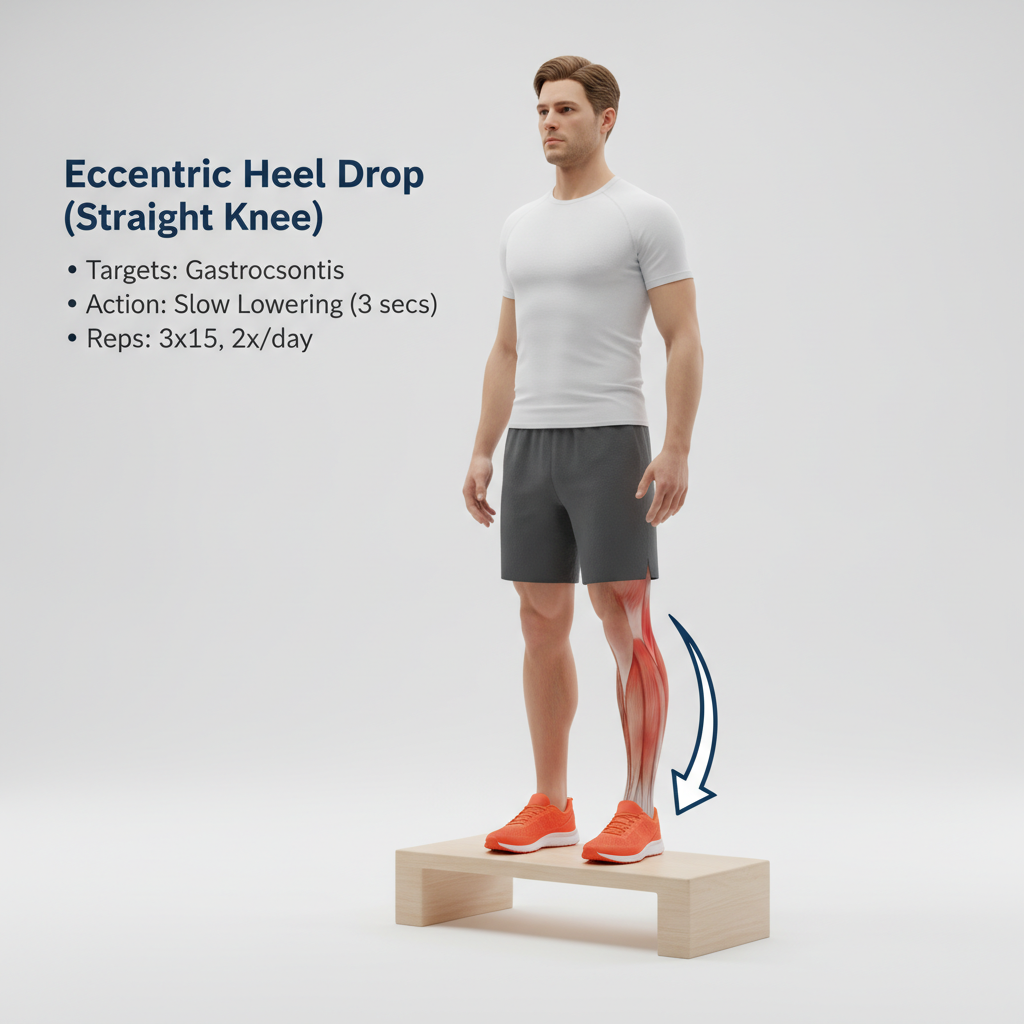
These exercises are a form of progressive tendon loading that help restore load tolerance, reduce symptoms, and improve return-to-activity outcomes when performed consistently and with appropriate progression.
Types of Achilles tendinopathy and implications
Achilles tendinopathy usually presents as either mid-portion (2–6 cm above the heel) or insertional (at the heel bone). The location matters because it influences exercise selection and loading limits.
- Mid-portion tendinopathy: generally responds well to traditional eccentric loading, including techniques that use increased dorsiflexion (heel drop) on a step.
- Insertional tendinopathy: requires modification to avoid excessive compression at the tendon insertion—limit end-range dorsiflexion and prefer flat-surface exercises or seated loading.
Common protocols: Alfredson and alternatives
The Alfredson protocol is the most widely known eccentric program for Achilles tendinopathy. It emphasizes slow, repeated heel drops with high volume over several weeks. Many clinicians use Alfredson as a starting point and adapt based on pain, response, and type of tendinopathy.
Heavy slow resistance (HSR) training and isometric holds are evidence-based alternatives or complements. HSR uses slower bilateral or unilateral concentric-eccentric loading and may be easier to progress for athletes. Isometric loading can provide short-term pain relief and improve muscle activation before introducing higher-load eccentric work.
Alfredson protocol (classic)
- Exercise: Standing calf raise off a step. Rise with both feet, transfer weight to the affected side, then slowly lower the heel below step level (eccentric phase).
- Dosage: 3 sets of 15 repetitions, performed twice daily (90 reps/day), for 12 weeks.
- Variations: Do both straight-knee (gastrocnemius emphasis) and bent-knee (soleus emphasis) versions to load the entire triceps surae complex.
- Pain guidance: Mild to moderate tendon pain during exercise is acceptable for many people; stop if pain increases substantially or function worsens over days.
Modifications for insertional tendinopathy
- Avoid deep heel drops into end-range dorsiflexion; perform eccentric lowering on a flat surface or stop just short of end-range.
- Reduce volume initially (for example, 3 sets of 10 once daily) and progress as tolerated.
- Consider seated calf raises or toe-raise machines to reduce compression at the heel during early rehab.
How to perform eccentric heel drops (step-by-step)
Performing the exercise with correct tempo and alignment is crucial to get the therapeutic effect while reducing injury risk. Start slowly and prioritize quality over quantity.
- Position: Stand on a step with the forefoot and toes on the edge and heels free.
- Start: Use both feet to push up onto your toes (concentric phase), then transfer weight to the injured side and slowly lower the heel below the step level over 3–5 seconds (eccentric phase).
- Tempo: Control the descent; return to the start using both feet to avoid concentrically loading the injured tendon.
- Reps and sets: Follow the chosen protocol (e.g., Alfredson) and stop if pain worsens beyond an acceptable level the following day.
Progression principles
Progress loading based on pain, function, and objective strength. General rules include increasing load before volume, monitoring pain responses, and using pain-guided progression (pain allowed up to 3/10 during exercise in many programs).
- Increase load by adding weight (backpack, vest) once exercises feel easy and symptoms are stable.
- Move from bilateral to unilateral loading to increase intensity.
- Transition to plyometrics and sport-specific loading only when pain is controlled and strength benchmarks are met.
Complementary treatments and considerations
Rehab is multimodal. Address footwear, training load, biomechanics, and calf flexibility. Shockwave therapy, load management, and orthotics can be adjuncts when indicated, but they do not replace progressive loading as the foundation of tendon rehab.
Isometric holds (e.g., 45-second plantarflexion holds) can be used pre-training to reduce pain and improve capacity. Incorporate hip and core strengthening, gait retraining, and gradual return-to-run plans for athletes.
Red flags and when to see a clinician
Seek urgent evaluation if you experience sudden severe pain, a popping sensation, visible gap in the tendon, or inability to push off the injured leg—these suggest a possible rupture. If symptoms fail to improve after 12 weeks of consistent loading or worsen with progressive exercise, consult a sports physician or physiotherapist for imaging and individualized management.
Typical timeline and outcomes
Most patients with mid-portion tendinopathy respond within 8–12 weeks of consistent eccentric or HSR training, though full recovery and return to high-level sport may take 3–6 months. Outcomes improve with adherence, gradual load progression, and addressing contributing factors such as training errors or poor footwear.
Practical tips for success
- Be consistent: daily or twice-daily sessions as prescribed for the first 12 weeks are common.
- Track symptoms with a simple pain and function log to guide progression.
- Combine exercises with realistic load management—reduce running or jumping early, then slowly reintroduce.
- Work with a clinician for personalized modifications if pain is severe, if you have insertional tendinopathy, or if you are returning to elite sport.
Summary
Eccentric loading for Achilles tendonitis rehab is a cornerstone of conservative management for Achilles tendinopathy, particularly mid-portion injuries. When combined with proper progression, pain-guided progression, and attention to biomechanics and training load, eccentric programs produce reliable reductions in pain and improvements in function.
If you are unsure which protocol suits your tendon or have persistent symptoms, consult a licensed physiotherapist or sports medicine specialist for a tailored program and supervised progression.