The thoracic spine, the segment of your back between your neck and lower back, is designed for movement and flexibility. However, hours spent hunched over a computer screen can significantly restrict its natural range of motion, contributing to a host of musculoskeletal issues.
Understanding Your Thoracic Spine: The Mid-Back’s Mission
Your thoracic spine comprises 12 vertebrae (T1-T12) and serves as the anchor point for your ribs, forming a protective cage around vital organs. Unlike the highly mobile cervical (neck) and lumbar (lower back) spines, the thoracic spine’s primary role includes providing stability while also allowing for significant rotation and extension.

This section of your spine is crucial for maintaining good posture, facilitating deep breathing, and enabling a full range of motion in your shoulders and arms. When its mobility is compromised, the ripple effect can be felt throughout your entire body.
The Sedentary Trap: How Desk Work Affects Your Mid-Back
The typical desk posture often involves a rounded upper back (thoracic kyphosis), protracted shoulders, and a forward head position. Sustaining this position for extended periods causes the muscles in the front of your chest to shorten and tighten, while those in your upper back become overstretched and weak.
Over time, this imbalance leads to a stiff, immobile thoracic spine. You might experience chronic upper back pain, neck pain, headaches, and even shoulder impingement. Furthermore, restricted thoracic mobility can hinder your ability to take full, deep breaths, impacting energy levels and concentration.
Common Symptoms of Poor Thoracic Mobility:
- Persistent upper back pain and stiffness.
- Neck and shoulder discomfort.
- Difficulty sitting upright for long periods.
- Reduced range of motion in shoulders and arms.
- Feeling “hunched” or rounded in the upper back.
- Occasional numbness or tingling in the arms (less common, but possible due to nerve impingement).
The Profound Benefits of Enhancing Thoracic Mobility
Prioritizing thoracic spine mobility offers a multitude of benefits that extend far beyond simply easing back pain. It’s a foundational element for a healthy, functional body, especially for those with a sedentary occupation.
Key Advantages Include:
- Reduced Pain and Stiffness: Directly addresses the root cause of upper back and neck discomfort.
- Improved Posture: Helps you sit taller and stand straighter, naturally aligning your head, neck, and shoulders.
- Enhanced Breathing: A mobile thoracic spine allows your rib cage to expand more fully, leading to deeper, more efficient breathing.
- Better Shoulder Health: Critical for overhead movements, preventing impingement and improving overall shoulder function.
- Increased Energy Levels: Good posture and efficient breathing can reduce fatigue and boost vitality.
- Prevention of Future Issues: A mobile spine is a resilient spine, less prone to injury and degenerative changes.
Essential Thoracic Mobility Exercises for Desk Workers
Incorporating a few simple yet effective exercises into your daily routine can make a significant difference. Remember to perform these movements gently, listening to your body, and never pushing into pain. Consistency is key!
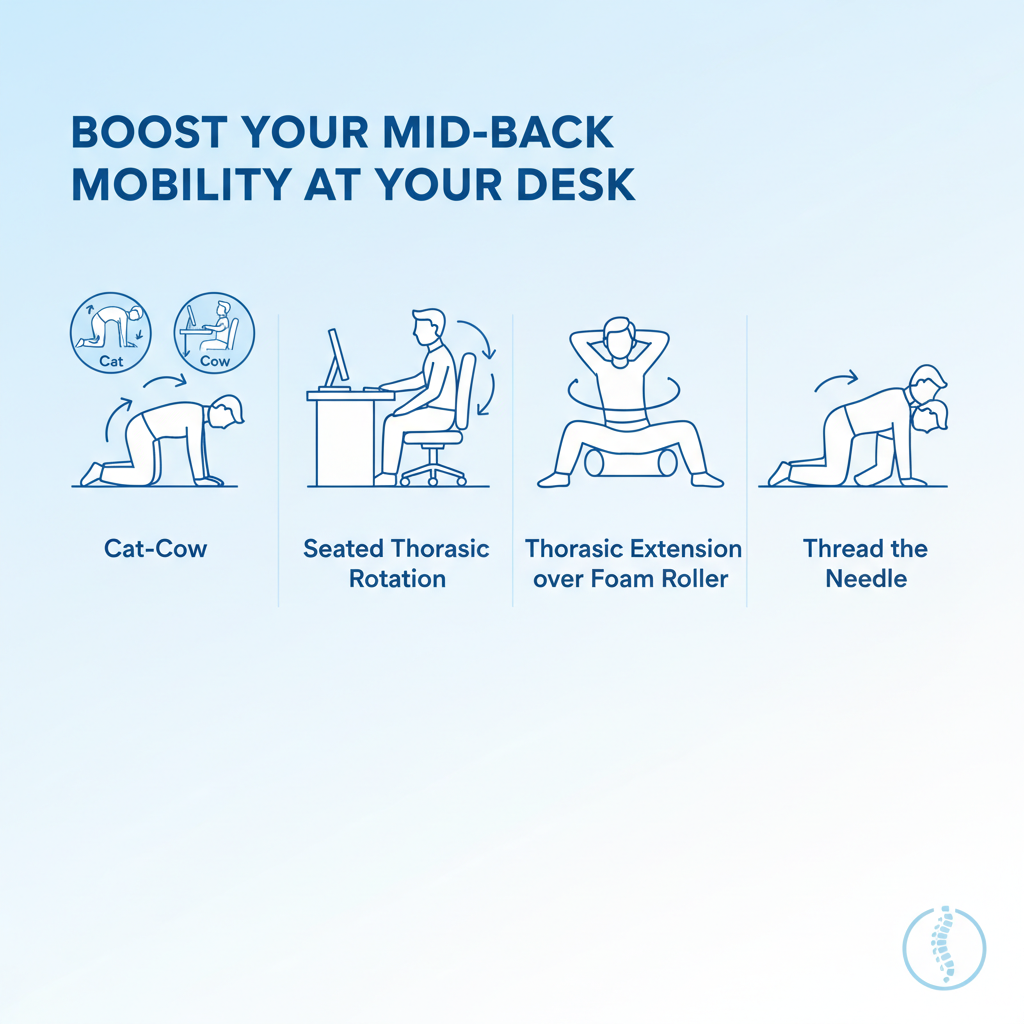
1. Cat-Cow Stretch (Seated or Kneeling)
Begin on your hands and knees, or seated upright in a chair with your feet flat. For cat, round your back, tuck your chin, and gently draw your navel towards your spine. For cow, arch your back, lift your chest and tailbone, and look slightly upwards. Flow smoothly between these two positions, focusing on moving each segment of your thoracic spine. Perform 10-15 repetitions.
2. Thoracic Extension Over a Foam Roller or Rolled Towel
Lie on your back with a foam roller or tightly rolled towel positioned perpendicular to your spine, just below your shoulder blades. Support your head with your hands. Gently arch your back over the roller, extending your spine. You can slightly shift the roller up or down your thoracic spine to target different areas. Hold for 30 seconds, repeating 2-3 times.
3. Seated Thoracic Rotations
Sit upright in your chair with your feet flat on the floor. Place your hands behind your head or cross them over your chest. Keeping your hips stable, gently twist your upper body to one side, leading with your rib cage. Hold briefly, then return to center and twist to the other side. Aim for 8-12 rotations per side, focusing on control rather than speed.
4. Thread the Needle
Start on your hands and knees. Reach one arm underneath your body, palm facing up, threading it through the space between your opposite hand and knee. Allow your shoulder and the side of your head to rest on the floor as you gently twist your upper back. Hold for 30-60 seconds, then switch sides. This stretch effectively targets thoracic rotation.
5. Wall Angels
Stand with your back against a wall, feet shoulder-width apart, about 6 inches from the wall. Press your head, upper back, and glutes against the wall. Bring your arms up so your elbows and wrists are touching the wall, making a “goal post” shape. Slowly slide your arms up and down the wall, trying to maintain contact with your head, elbows, and wrists. Perform 8-12 repetitions, feeling the stretch in your chest and activation in your upper back.
Integrating Mobility into Your Workday: Practical Tips
Making thoracic mobility a regular part of your routine doesn’t require a lot of time or equipment. Small, consistent efforts throughout the day can yield significant results.
- Take Micro-Breaks: Every 30-60 minutes, stand up, walk around, and perform a few quick stretches.
- Desk Setup Check: Ensure your monitor is at eye level, your chair supports your lower back, and your keyboard and mouse are within easy reach to prevent slumping.
- Hydration and Movement: Keep a water bottle handy; frequent trips to refill it naturally encourage movement breaks.
- Set Reminders: Use an app or a simple timer to prompt you to move and stretch.
- Incorporate Posture Cues: Periodically check in with your posture – are your ears aligned over your shoulders? Is your chest open?
Beyond Exercises: A Holistic Approach to Spinal Health
While specific mobility exercises are vital, a comprehensive approach to spinal health for desk workers includes several other key elements.
- Ergonomic Workstation: Invest in an ergonomic chair, monitor stand, and keyboard to support optimal posture.
- Regular Physical Activity: Engage in activities that promote overall flexibility, strength, and cardiovascular health, such as yoga, Pilates, swimming, or walking.
- Strength Training: Focus on strengthening your core muscles, glutes, and upper back muscles to better support your spine.
- Mindfulness and Stress Reduction: Stress can often manifest as muscle tension in the neck and upper back. Practices like meditation can help.
- Professional Guidance: If you experience persistent pain or discomfort, consult with a physical therapist, chiropractor, or your doctor. They can provide personalized assessments and treatment plans.
Conclusion
Sedentary desk work poses significant challenges to our spinal health, particularly for the thoracic spine. By understanding its importance and proactively incorporating targeted mobility exercises, desk workers can dramatically improve their posture, reduce pain, and enhance their overall quality of life. Make thoracic spine mobility for desk workers a non-negotiable part of your daily routine – your body will thank you for it with greater comfort, strength, and vitality.