Understanding Shoulder Impingement in Swimmers
Shoulder impingement syndrome occurs when the tendons of the rotator cuff and the bursa (a fluid-filled sac) become compressed in the subacromial space, the area between the top of the humerus (upper arm bone) and the acromion (part of the shoulder blade). This compression causes irritation, inflammation, and pain, especially during overhead arm movements – which, for swimmers, is every stroke.
Symptoms often include pain in the shoulder, particularly when lifting the arm, reaching behind the back, or during specific phases of the swim stroke. Swimmers might notice a dull ache at rest, which sharpens with activity, along with possible weakness or a limited range of motion.

Why Swimmers Are Prone to Shoulder Impingement
The repetitive, overhead nature of swimming makes the shoulder joint highly susceptible to impingement. Each swim stroke involves a complex series of movements that require significant shoulder mobility, stability, and strength. Factors contributing to impingement in swimmers include:
-
Repetitive Overhead Motion: Swimmers perform thousands of arm rotations during a single training session, constantly placing stress on the rotator cuff tendons and surrounding structures.
-
Muscle Imbalances: Strong pectoral and latissimus dorsi muscles, often overdeveloped in swimmers, can pull the shoulder forward, contributing to poor posture and narrowing the subacromial space. Weakness in the rotator cuff or scapular stabilizers can exacerbate this.
-
Poor Technique: Incorrect stroke mechanics, such as a dropped elbow during the pull phase or over-rotation of the body, can increase the impingement risk.
-
Lack of Flexibility: Tightness in the chest, lats, and posterior shoulder capsule can restrict the shoulder’s natural movement, forcing it into compromised positions during the stroke.
-
Fatigue: As swimmers tire, their form often degrades, leading to increased strain on the shoulder joint and making it more vulnerable to injury.
The Role of Stretching in Prevention and Management
Stretching plays a crucial role in both preventing and managing shoulder impingement. Regular stretching helps to restore and maintain optimal flexibility, improving the range of motion in the shoulder joint and surrounding structures. This can alleviate tension, correct muscle imbalances, and create more space within the shoulder joint, reducing compression of the rotator cuff tendons.
By increasing the flexibility of tight muscles and improving joint mobility, stretching allows for more efficient and pain-free movement, enhancing stroke mechanics and overall swimming performance. It is an indispensable component of any swimmer’s injury prevention and rehabilitation program.
Key Principles for Effective Shoulder Impingement Stretches
To get the most out of your stretching routine and avoid aggravating your shoulder, keep these principles in mind:
-
Warm Up First: Always perform light cardiovascular activity for 5-10 minutes (e.g., easy swimming, jogging) before stretching cold muscles.
-
Gentle and Gradual: Never force a stretch into pain. You should feel a gentle pull, not sharp discomfort. If you experience pain, ease off or stop the stretch.
-
Hold Steady: Hold each static stretch for 20-30 seconds. Avoid bouncing, as this can activate the stretch reflex and increase the risk of injury.
-
Consistency is Key: Incorporate these stretches into your routine 3-5 times a week, ideally after your swim or training session when muscles are warm.
-
Listen to Your Body: Pay attention to how your body feels. If a stretch consistently causes pain, consult a physical therapist or medical professional.
Essential Shoulder Impingement Stretches for Swimmers
Here are several targeted stretches designed to address common areas of tightness in swimmers and help alleviate or prevent shoulder impingement:
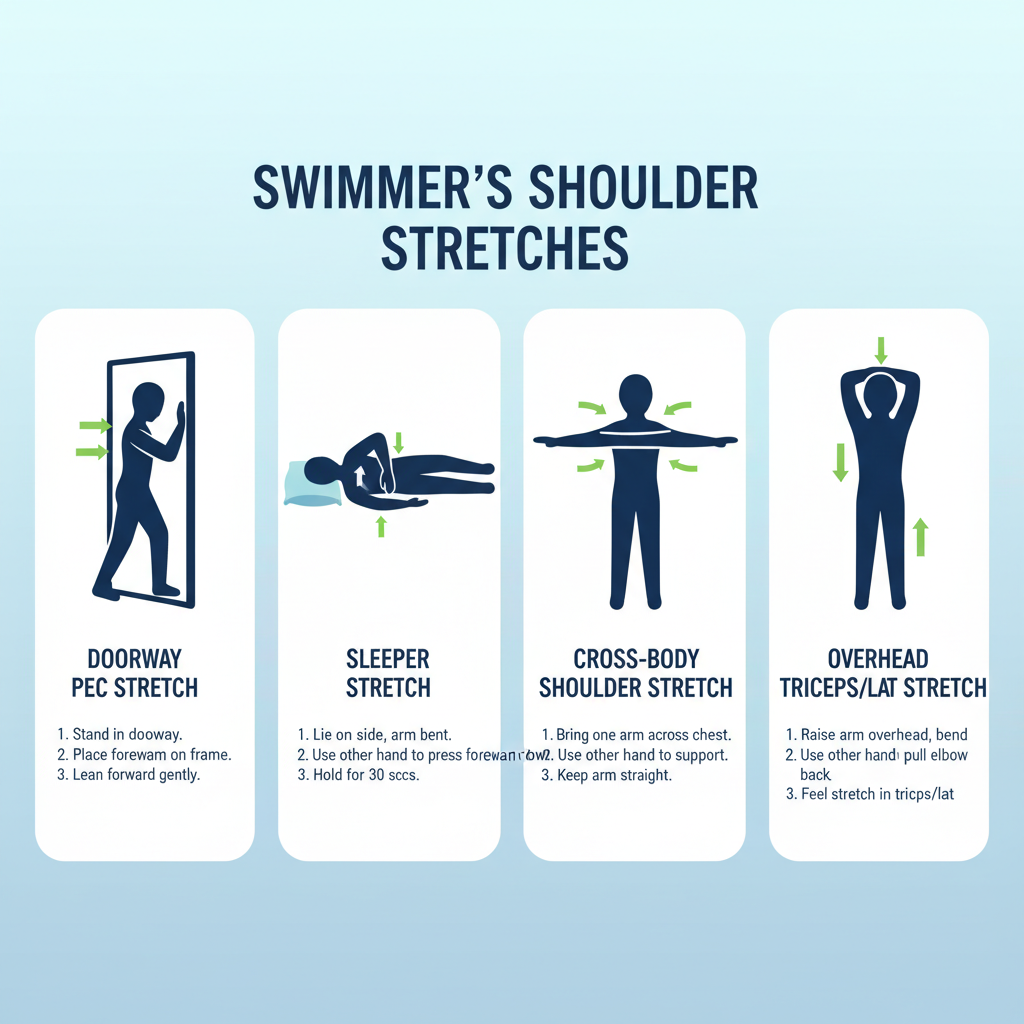
1. Pectoral Doorway Stretch
This stretch targets the chest muscles (pectorals), which can become tight in swimmers and pull the shoulders forward, contributing to impingement.
-
Stand in a doorway with your forearms resting on each side of the frame, elbows bent at a 90-degree angle, slightly below shoulder height.
-
Step forward gently with one foot through the doorway until you feel a stretch across your chest and the front of your shoulders.
-
Keep your back straight and avoid arching your lower back.
-
Hold for 20-30 seconds. Repeat 2-3 times.
2. Sleeper Stretch (Posterior Rotator Cuff)
The sleeper stretch targets the posterior capsule and external rotators of the shoulder, which can become tight in overhead athletes.
-
Lie on your affected side with your arm extended directly out in front of you, elbow bent at 90 degrees, and your palm facing down towards the ceiling.
-
Use your other hand to gently push your forearm down towards the floor, rotating your shoulder internally.
-
You should feel a stretch in the back of your shoulder. Keep your shoulder blade flat on the ground and avoid shrugging your shoulder up.
-
Hold for 20-30 seconds. Repeat 2-3 times on each side.
3. Cross-Body Arm Stretch (Posterior Deltoid and Capsule)
This stretch helps improve flexibility in the posterior shoulder, including the deltoid and rotator cuff muscles.
-
Bring one arm across your chest, keeping it straight at shoulder height.
-
Use your other hand to gently pull your elbow further across your body, deepening the stretch.
-
Ensure your shoulder is relaxed and not shrugging towards your ear.
-
Hold for 20-30 seconds. Repeat 2-3 times on each side.
4. Thoracic Extension with Foam Roller
Improving mobility in the upper back (thoracic spine) is critical for shoulder health, as a stiff upper back can force the shoulder to compensate and impinge.
-
Lie on your back with a foam roller positioned horizontally under your upper to mid-back (avoid the lower back).
-
Place your hands behind your head to support your neck, keeping your elbows wide.
-
Gently extend your upper back over the foam roller, allowing your head to drop towards the floor.
-
You can slowly roll up and down a small segment of your thoracic spine or hold a static stretch in a tender spot.
-
Perform for 30-60 seconds.
5. Wall Angels (Scapular Mobility and Stability)
Wall angels improve scapular control and promote proper shoulder mechanics, reducing impingement risk.
-
Stand with your back, head, and glutes pressed against a wall. Keep your feet about 6-12 inches from the wall.
-
Bring your arms up so your elbows and wrists are also against the wall, forming a “W” shape with your arms.
-
Slowly slide your arms up the wall, trying to keep your wrists and elbows in contact with the wall, until your arms are fully extended overhead (forming a “Y”).
-
Reverse the movement slowly, bringing your arms back to the “W” position.
-
Perform 8-12 repetitions. Focus on smooth, controlled movement without shrugging.
6. Overhead Triceps/Lat Stretch
This stretch targets the triceps and latissimus dorsi, muscles that can become tight and restrict overhead arm movement.
-
Stand or sit tall. Raise one arm straight overhead, bending your elbow so your hand touches your upper back or the back of your neck.
-
Use your other hand to gently push down on the raised elbow, deepening the stretch in your triceps and down the side of your body (lat).
-
Keep your core engaged and avoid arching your lower back or leaning to the side.
-
Hold for 20-30 seconds. Repeat 2-3 times on each side.
When to Seek Professional Help
While these shoulder impingement stretches for swimmers can be highly beneficial, it’s crucial to know when to seek professional medical advice. If you experience any of the following, consult a doctor, physical therapist, or sports medicine specialist:
-
Persistent or worsening pain despite regular stretching and rest.
-
Sharp, sudden pain or a feeling of instability in your shoulder.
-
Significant weakness or inability to lift your arm.
-
Numbness or tingling in your arm or hand.
-
Pain that disrupts your sleep or daily activities.
A professional can accurately diagnose the cause of your shoulder pain, rule out more serious injuries, and provide a personalized treatment plan that may include advanced stretching, strengthening exercises, manual therapy, or other interventions.
Conclusion
Shoulder impingement doesn’t have to be a career-ending diagnosis for swimmers. By consistently incorporating these targeted shoulder impingement stretches for swimmers into your routine, you can significantly enhance flexibility, improve shoulder mechanics, and reduce your risk of injury. Prioritize proper technique, listen to your body, and don’t hesitate to seek professional guidance to keep your shoulders healthy and strong for countless laps to come.