This comprehensive guide will delve into why optimal wrist flexibility is crucial for weightlifting, explore the underlying anatomy, and provide a series of effective, easy-to-follow wrist mobility exercises designed to improve your range of motion, alleviate discomfort, and protect your joints.
Why Wrist Mobility Matters for Every Weightlifter
Many weightlifters focus solely on major muscle groups, often overlooking the vital role of smaller, stabilizing joints like the wrists. However, the wrists act as a critical link between your hands and forearms, directly impacting your ability to execute lifts safely and efficiently.
Preventing Injury and Pain
Poor wrist flexibility can lead to a host of problems. When your wrists lack the necessary range of motion, they are forced into compromised positions under load, increasing the risk of strains, sprains, and more chronic issues like carpal tunnel syndrome or tendinitis. Adequate wrist preparation helps absorb impact and distribute force evenly, protecting delicate ligaments and tendons.
Enhancing Performance and Form
Optimal wrist mobility is key to maintaining proper bar path and achieving the correct racking position in lifts like the front squat or overhead press. It allows for a stronger, more stable grip, which directly translates to lifting heavier weights with better control. Improved wrist flexibility can significantly enhance your ability to perform complex movements such as the snatch and clean and jerk, where wrist position is paramount.
Long-Term Joint Health
Regularly engaging in wrist mobility exercises contributes to the long-term health of your wrist joints. It encourages the production of synovial fluid, which lubricates the joints, and helps maintain the elasticity of surrounding connective tissues. This proactive approach can delay degenerative changes and keep you lifting strong for years to come.
Understanding Wrist Anatomy and Movement
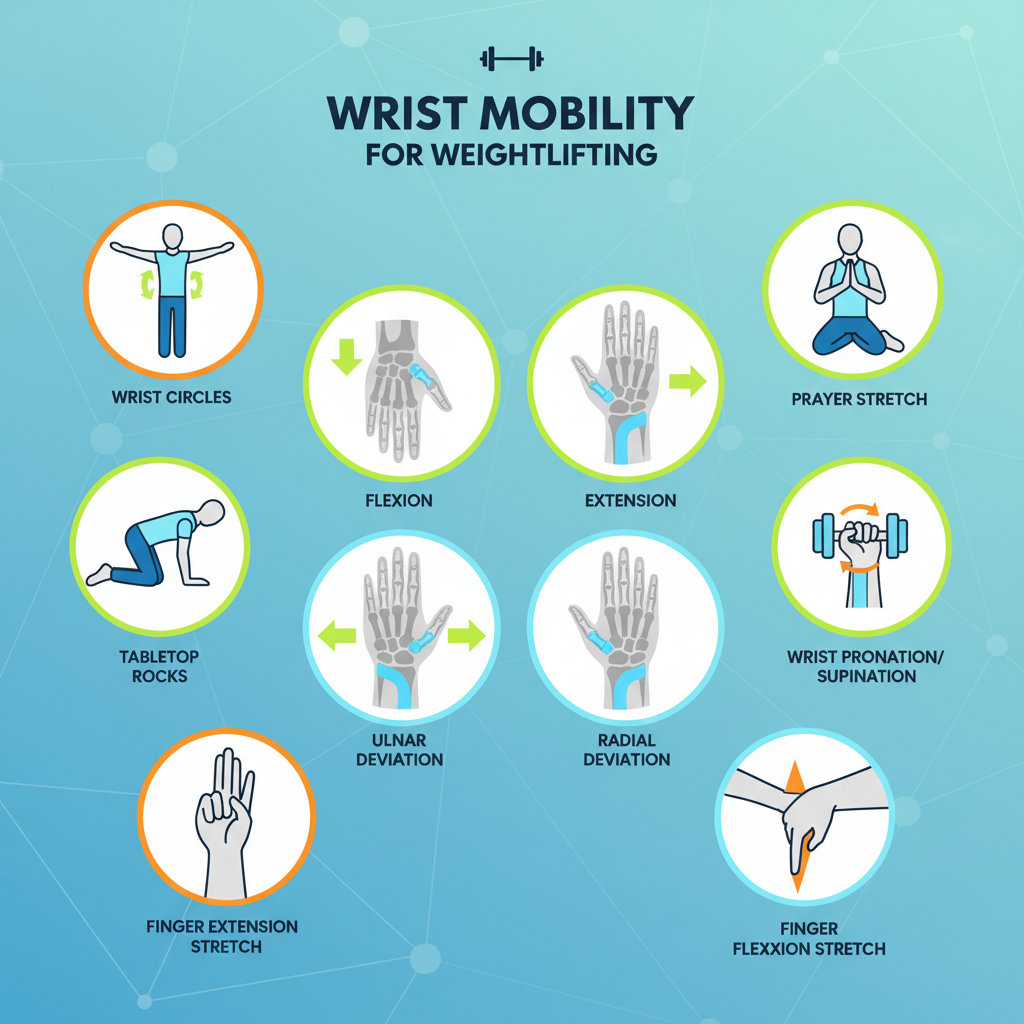
The wrist is a complex joint composed of eight small carpal bones, the distal ends of the radius and ulna (forearm bones), and a network of ligaments, tendons, and muscles. These structures work in concert to allow for four primary movements: flexion (bending the hand down), extension (bending the hand back), ulnar deviation (bending towards the pinky finger), and radial deviation (bending towards the thumb).
For weightlifting, sufficient extension and flexion are particularly important, especially when holding a barbell in a front rack or overhead position. Understanding these basic movements helps you target specific areas with your mobility drills.
Essential Wrist Mobility Drills for Weightlifting Warm-ups
Incorporate these drills into your warm-up routine before every lifting session. Remember to perform each movement slowly and controlled, stopping if you feel any sharp pain.
1. Wrist Circles
- Extend your arms straight out in front of you, parallel to the floor.
- Make loose fists with your hands or keep your fingers extended.
- Slowly rotate your wrists in large circles, first clockwise for 10-15 repetitions, then counter-clockwise for 10-15 repetitions.
- Focus on achieving the largest possible range of motion without discomfort.
2. Wrist Flexion and Extension Stretch
- Extend one arm straight out with your palm facing down.
- Use your other hand to gently pull the fingers of the extended hand downwards, stretching the top of your wrist and forearm. Hold for 15-20 seconds.
- Next, point your fingers downwards and gently pull them towards your body, stretching the underside of your wrist and forearm. Hold for 15-20 seconds.
- Repeat on the other arm.
3. Prayer Stretch / Reverse Prayer Stretch
- Prayer Stretch: Bring your palms together in front of your chest, fingers pointing upwards. Slowly lower your hands towards your waist, keeping your palms pressed together, until you feel a good stretch in your wrists and forearms. Hold for 20-30 seconds.
- Reverse Prayer Stretch: Place the backs of your hands together in front of your chest, fingers pointing downwards. Gently raise your hands towards your chest, keeping the backs of your hands pressed together, until you feel a stretch. Hold for 20-30 seconds.
4. Tabletop Wrist Rocks (Fingers Forward, Backward, Sideways)
- Start on all fours with your hands directly under your shoulders and knees under your hips.
- Fingers Forward: Point your fingers directly forward. Gently rock your torso forward and back, feeling the stretch in your wrists. Perform 10-15 repetitions.
- Fingers Backward: Carefully rotate your hands so your fingers point towards your knees. Gently rock your torso back towards your heels, stretching the forearms and wrists. Perform 10-15 repetitions. This can be intense, so be gentle.
- Fingers Sideways: Point your fingers outwards, away from each other. Gently shift your weight from side to side, stretching the inner and outer aspects of your wrists. Perform 10-15 repetitions per side.
5. Dumbbell Wrist Rotations (Light Weight)
- Hold a very light dumbbell (1-2 lbs) in one hand, palm facing up, with your forearm resting on your thigh or a bench.
- Allow the dumbbell to hang off the edge of your knee/bench, letting your wrist fully extend downwards.
- Slowly curl the dumbbell upwards using only your wrist, bringing it into full flexion.
- Perform 10-15 controlled repetitions, then repeat with the palm facing down.
- Switch arms. This exercise builds both mobility and controlled strength.
6. Foam Roller Wrist Massage
- While not a mobility drill in the traditional sense, using a foam roller or even a lacrosse ball to gently roll out your forearms can release tightness that impacts wrist mobility.
- Place your forearm on a foam roller or ball, applying gentle pressure. Roll slowly from your elbow down to your wrist, pausing on any tender spots.
- Perform for 1-2 minutes per forearm.
Integrating Wrist Mobility into Your Weightlifting Routine
Consistency is paramount when it comes to improving and maintaining wrist mobility. Make these drills a non-negotiable part of your lifting regimen.
Before Your Workout: Dynamic Warm-up
Perform a selection of the wrist circles, flexion/extension stretches, and tabletop rocks as part of your general warm-up. This prepares the wrists for the demands of lifting, increasing blood flow and range of motion.
After Your Workout: Static Stretching and Recovery
Dedicate a few minutes post-workout to longer, static holds of stretches like the prayer stretch and reverse prayer stretch. This helps to improve overall flexibility and aids in recovery.
Daily Practice: Consistency is Key
Even on non-lifting days, a few minutes of wrist mobility work can be highly beneficial. This can be done while sitting at a desk, watching TV, or during breaks, reinforcing healthy wrist movement patterns.
When to Be Cautious and Seek Professional Advice
While these drills are generally safe and beneficial, it’s crucial to listen to your body. If you experience sharp pain, numbness, tingling, or increased discomfort during any exercise, stop immediately. Do not push through pain. If you have pre-existing wrist injuries, chronic pain, or conditions like carpal tunnel syndrome, consult with a physical therapist or medical professional before starting any new mobility routine. They can provide a personalized assessment and tailored recommendations.
Conclusion: Invest in Your Wrists, Elevate Your Lifts
Neglecting wrist mobility is a common oversight among weightlifters, but it can be a costly one in terms of performance plateaus and preventable injuries. By consistently incorporating these essential wrist mobility drills for weightlifting into your routine, you’re not just warming up; you’re actively investing in your long-term lifting success, joint health, and overall athletic longevity. Prioritize your wrists, and watch your lifting potential soar.